
The Portuguese Camino, from Portugal to Santiago
The Portuguese Camino is the route that leads to Santiago de Compostela from Portugal. It has two main variants that join at Redondela: the Portuguese Camino Central Route, which leaves Lisbon and climbs through the interior, and the Portuguese Camino Coastal Route, which leaves Porto and runs beside the Atlantic. In this guide you will find their stages with kilometres, the albergues in each town with price, beds and opening season, and the towns the routes pass through.
Central Route or Coastal Route
| Central Route | Coastal Route | |
|---|---|---|
| Usual starting point | Lisbon, Porto or Tui | Porto or Vigo |
| From Porto | 11 stages · about 241 km (149.7 miles) | 13 stages · about 271 km (168.3 miles) |
| Last 100 km | From Tui: 6 stages · 116 km (72.0 miles) | From Vigo: 5 stages · 99–101 km (61.5–62.7 miles) |
| Scenery | Inland: vineyards, Barcelos, Ponte de Lima | Coast: beaches, boardwalks, Oia, Baiona |
| Joins | At Redondela | At Redondela |
Kilometres calculated by adding up the usual stages. The last four stages, from Redondela to Santiago via Pontevedra, Caldas de Reis and Padrón, are shared by both routes.
Where to start the Portuguese Camino
The most popular starting point is Tui, the first Galician town on the Central Route: from there about 116 km and six stages remain to Santiago, enough for the Compostela. You can follow it step by step in the Camino de Santiago from Tui. On the Coastal Route, the short start is Vigo, about 100 km away: see the Camino de Santiago from Vigo to decide whether it suits you to start there or one stage earlier.
With two weeks, the usual choice is to leave from Porto on either route. Lisbon is for those with almost a month: it is about 608 km on the Central Route.
The Compostela and the credential
To receive the Compostela at the Pilgrim’s Office in Santiago you must walk at least the last 100 km and carry a credential with two stamps per day on that stretch. If you start outside Spain, at least 70 km must be on Spanish territory.
Albergues on the Portuguese Camino
Each accommodation listing in this guide has the address, phone, website, services, check-in times, a map and the date on which we reviewed the data. You can search for them on the map above or town by town in the towns of the Portuguese Camino.
Other Camino de Santiago routes
The Portuguese Camino is just one of the pilgrim routes that end in the Obradoiro square. The best known is the Camino Francés (French Way), which enters Spain at Roncesvalles and crosses Navarre, La Rioja, Castile and León and Galicia: it draws the most pilgrims every year and has the most albergues.
In the north, the Camino del Norte (Northern Way) follows the Cantabrian coast from Irún and joins the Francés at Arzúa. The Primitivo (Original Way), which King Alfonso II is said to have followed from Oviedo, crosses the mountain passes of Asturias and enters Lugo through its Roman walls.
Each has its own landscape and pace. If the Portuguese Camino leaves you wanting more, start here.


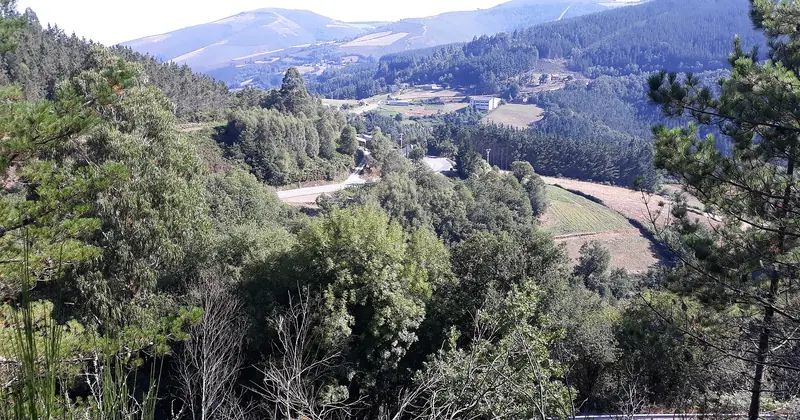
Photos: Camino Francés (French Way): José Luis Filpo Cabana · Wikimedia Commons · CC BY 3.0 — Camino del Norte (Northern Way): José Antonio Gil Martínez · Wikimedia Commons · CC BY 2.0 — Camino Primitivo (Original Way): Simon Burchell · Wikimedia Commons · CC BY-SA 4.0.
Getting there and back
Most pilgrims from the UK and the US fly into Porto (Francisco Sá Carneiro airport, OPO) or Lisbon (Humberto Delgado airport, LIS). From Porto airport, metro line E (violet) takes about half an hour to the city centre (Trindade), a short walk from the cathedral where the Camino starts. Lisbon airport is on the metro red line, about 7 km (4 miles) north of the centre.
To get home, buses run several times a day from Santiago de Compostela to Porto and Porto airport (about 3.5 to 4 hours), and Santiago airport (SCQ) has direct flights to a number of European cities. Check current timetables before you travel.
Frequently asked questions
How many kilometres is the Portuguese Camino?
It depends on where you start: about 608 km from Lisbon on the Central Route, about 241 km from Porto on the Central Route, about 271 km from Porto on the Coastal Route and about 116 km from Tui.
Which is better, the Portuguese Camino Central Route or the Coastal Route?
It depends what you are looking for: the Central Route runs inland, among vineyards and historic towns, with the Labruja climb; the Coastal Route is somewhat longer from Porto, flatter and runs beside the sea. The two join at Redondela.
Where do you have to start the Portuguese Camino to get the Compostela?
From Tui on the Central Route (about 116 km) or, on the Coastal Route, from Vigo, which sits right on the 100 km limit. To be safe on the Coastal Route, start at A Ramallosa or Baiona.
How many days does the Portuguese Camino take?
Six days from Tui, five from Vigo, about two weeks from Porto and almost a month from Lisbon.